

It was the glorious 70s-80s decade of the last century. The heart of our generation, at least the urban and educated youth of the time, vibrated to the left. It delighted in ideas, writings, plays, films, and committed songs. It appropriated them as horizons capable of popularising—to use the concepts dear to Antonio Gramsci—"Cultural Hegemony", to concretise the symbiosis between the popular class "for itself" and the "organic intellectuals", essential steps for the suns of the "Grand Soir" to illuminate the Moroccan sky, then poisoned by the Makhzen.
In terms of the art of the moment that is song, that generation, in those times, had become a master in the art (devoid of verses and choruses) of separating the wheat from the chaff. And everyone prided themselves on having "broken" with the "opium of the people" embodied by the so-called modern Moroccan song, even though it was, in our view, intrinsically conservative and retrograde ( (!and only listening to magnetic tape cassettes and 33 rpm vinyl records signed by Cheikh Imam, Marcel Khalifa, Abed Azrié, El Achikin… and obviously Nass El Ghiwane, Jil Jilala, es-Siham, Lemchaheb, and Saïd El-Maghribi…; some of which were acquired in secret, and others tolerated for open sale by the powerful Ministry of the Interior to weaken their "emancipatory" message!
Down with the "modern" songs broadcast on a loop by the State's "ideological apparatuses"! The Popular Forces would not be mistaken about theirs!
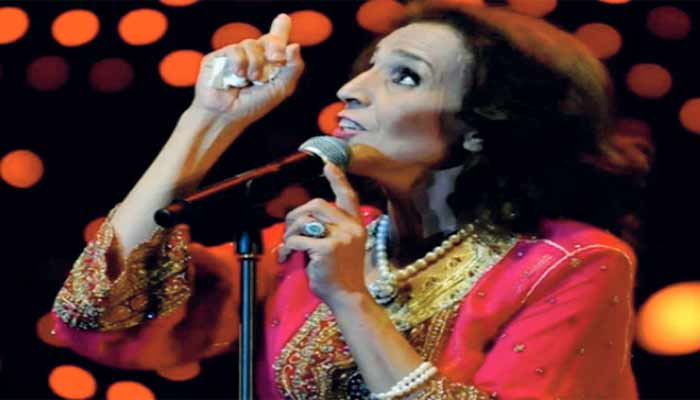
And yet, our musical "fundamentalism" was put to the test by "good grain" put in the spotlight by "the other side". Admittedly, there were few exceptions to the "chaff", and Naïma Samih was the most co-opted illustration by the young left-wing people.
Her presence, her voice, and her charisma, among other qualities, transcended the divide that our generation had erected in the artistic sphere. She was one of us! And she remained so after so much water had flowed under the bridges of the Oued that is life, our life in constant mutation. She sublimated us, intoxicated us, and made us put away in the cupboards of the obsolete the blinkers we had forged for ourselves.
Her fragility, her vulnerability, her origins, her journey, her modesty, her halo, that celestial smile, the fullness of her art… so many particularities which, combined with others, allowed her to reach the status of an essential artist, above the rest and blessed by all generations without exception. Venerated even by those for whom the profane world was split into two irreconcilable areas and listened to in palaces as well as in cottages.
Let us dare the qualifier: popular! Because she "formed the soundtrack of (our) life(s)", to paraphrase Martin Scorsese.
Naïma Samih, Diva of our reconciliation with ourselves, between ourselves, between a radical modernity that embraces us and an ancestral authenticity that imprints us.
And this voice, her hoarseness magnifying the extreme sensitivity that flows in the veins of the terroir, her accuracy adapting to the most complex polyphonies, her tessituras praising the human in the Being, notably the woman, and her breath humming the air and creating the sensation that Naïma is singing for our individuality alone, dismisses the audience to whisper in our ear! These vocal sounds on the voluptuousness of which we have loved and suffered so much, dreamed and confronted the daily life that tumbles, which we share with our parents and our children!
Another chorus,
a hoarseness,
an enchantment,
Lalla Naïma,
so that the white butterflies continue to graze on life and announce spring.
-----
- Testimony extracted from the collective work:
"Naïma Samih, a Tunisian legacy: testimonies about the hoarseness of melodic sorrow", publications of the Embassy of the Kingdom of Morocco in Tunisia, Spring 2012.