

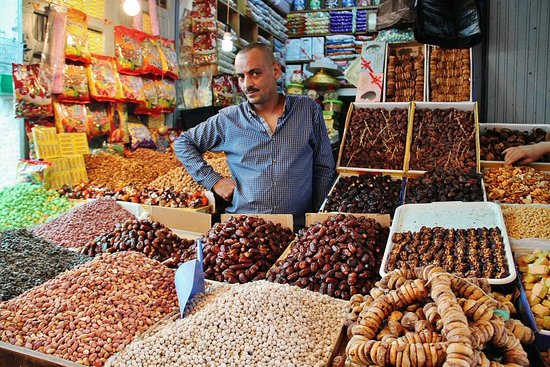
In the heart of Bouznika, the central market comes alive from the first light of day, and even more so with the arrival of the holy month of Ramadan, where the scents of spices, fresh coriander, and grilled fish mingle with the incessant clamour of merchants rubbing their hands in anticipation of the profits they expect to generate, and customers in search of good deals. As far as the eye can see, the stalls are overflowing with essential goods: lentils, chickpeas, dates, amber honey, semolina for the sacred baghrir, and of course, flour and oil, essential for msemmen and the harira for f'tour.
A customer, a man in his fifties with a sharp gaze, proudly places his well-filled basket on the counter of a vegetable seller. “With 100 dirhams, you can still manage well, provided you don't buy just anything, know how to juggle quantities, and don't give in to superfluous desires,” he says to a customer who was complaining about the high cost of living. “In Morocco, inflation is not as bad as elsewhere,” he continues with the same composure, weighing a bunch of mint. But a woman of a certain age does not share his optimism: “Before, we could eat sardine tagines with tomatoes all year round, especially during Ramadan. Today, it has become a luxury,” she sighs, her arms loaded with bags that are too light for her taste.
And yet, a passerby drops a piece of information that makes all the fish lovers present here raise an eyebrow: a sardine seller at the market is offering his kilo for 20 dirhams, well below the 25 or 30 displayed in the large neighbouring cities.
Thursday is joutia day in Bouznika. Kilometre-long queues head towards the old Souk square where street vendors occasionally spread out their makeshift trestles. Here, there are no flashy shop windows or electronic scales, but a raw and authentic effervescence. Crates of bright red tomatoes are priced at 8 dirhams a kilo, and juicy oranges start at 5 dirhams. A woman with the singing accent of the south flips through a bunch of coriander before putting it back: “Ramadan should be the month of sobriety. But today, it is above all that of overbidding,” she notes with a hint of bitterness.
And yet, Bouznika retains this very particular atmosphere, between commercial effervescence and preserved culinary traditions. If prices rise and nostalgic people sigh, the spirit of Ramadan resists in the aisles of the market and around the tables where, every evening, the breaking of the fast brings together families and neighbours in an immutable ritual, because sobriety does not depend only on the price of tomatoes or sardines, but on the love of sharing and the definition of true wealth.
Houda BELABD
An atypical city...
Bouznika has that something that many cities do not have. It is, precisely, its ability to adapt to every season of the year. While its beaches attract lovers of the Dolce vita as soon as the temperature exceeds 20°C, its markets, during Ramadan, attract both lovers of fish, the sea, calm, and relaxation during the weekend. Its city centre, meanwhile, seduces the many fans of mechoui all year round.
In this market near the railway station of this seaside town, the enchanting smell of bread just out of the oven mingles with the spicy scents of Ramadan preparations.
Between the good-natured jostling and the lively discussions about the high cost of living, a shared feeling floats in the air: that of an effervescence that is both familiar and precious where the holy month remains a time when ancestral rituals are perpetuated with fervour, despite economic constraints.