

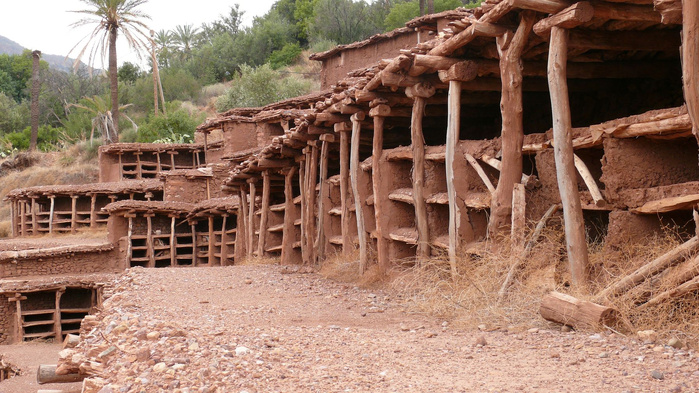
Perched at nearly 1,000 metres in altitude, on the southern foothills of the Western High Atlas, the Inzerki Apiary is recognised as one of the largest traditional beekeeping complexes still in operation. Located north of Agadir, this remarkable site embodies a living heritage, a witness to the ingenuity of the Berber communities of Souss Massa.
Restored in 2005 with respect for the original materials (stone, wood, and raw earth), this collective complex brings together hundreds of compartments intended to house swarms. Although not all are occupied today, the place retains its beekeeping vocation and its cultural importance. Managed by a local association bringing together seven members representing 42 families of the douar, the site often constitutes the sole source of income for its inhabitants.
The production of this terroir is renowned: the honey harvested there, derived from a varied and rich local flora, is among the most appreciated in the country. However, yields depend closely on climatic conditions. During particularly arid years, the swarms suffer: in 2025, production was limited to 40 active colonies compared to 140 in 2021.
Each hive is handcrafted from natural materials. The swarm is housed in a reed or bark cylinder, closed at the ends by palm discs, marked to indicate ownership. These containers are inserted into ventilated cases, and once filled, they are carefully emptied before being sealed again.
The choice of site is no coincidence. The sunny southern flank benefits from a stable microclimate conducive to the flourishing of numerous melliferous plant species: lavender, thyme, argan, almond, oak, palm.
Easily accessible, the village remains isolated nonetheless. An eight-kilometre track leads to the apiary, winding between ochre reliefs, carpeted with Mediterranean vegetation and traditional hamlets. This access route suffered from the last earthquake and requires urgent rehabilitation to preserve the activity and open the site further to the public.
The apiary is built in terraces and integrated into the landscape, in a rammed earth architecture that respects the environment. Each level is occupied by structures called Tizghatine, a type of collective compartment that houses the cylinders.
Although it is recognised in international beekeeping circles, Inzerki remains a confidential place. Few visitors take the road to this extraordinary heritage, yet it is described as an Amazigh "treasure". Steps are underway to obtain its inscription as a UNESCO World Heritage site.
The very principle of this collective apiary (locally called "Taddart ou Guerram") is based on inter-tribal cooperation. Families place their hives in the communal spaces according to an arrangement passed down from generation to generation.
The organisation of the site, its durability, and its cultural roots make it a rare example of rural cohesion. Each family preserves its know-how, passes on its landmarks, maintains its cylinders, and participates in the preservation of the whole. The whole forms a social and ecological ecosystem that deserves reinforced attention.
Inzerki is an identity landmark for the inhabitants of the Souss. It embodies a beekeeping tradition that respects nature, deeply rooted in the rhythms of the earth and the requirements of collective life. Faced with the challenges of climate change and increasing urbanisation, its safeguarding becomes a priority issue. Support for this traditional sector, whether institutional, associative, or touristic, represents an opportunity to consolidate a sustainable development model, in harmony with the territory and its resources.
