


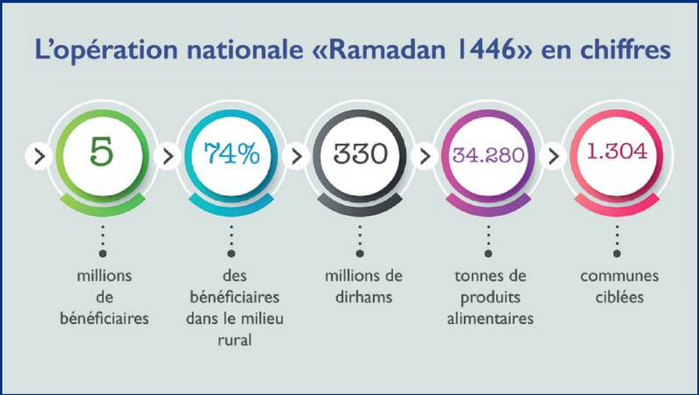
At the heart of the Youssoufia arrondissement in Rabat, and particularly in the Bouregreg district, young and old gathered on Monday to solemnly welcome His Royal Highness Crown Prince Moulay El Hassan and Her Royal Highness Princess Lalla Khadija, who gave the kick-off for the national “Ramadan 1446” operation. Supported by the Mohammed V Foundation for Solidarity on the occasion of the holy month of Ramadan, this campaign benefits one million households, or nearly 5 million people, and is not limited to the simple distribution of food. It carries the message of a nation united around the values of mutual aid and sharing. “This operation represents an opportunity every year to perpetuate the values of generosity and mutual aid that bind the different segments of Moroccan society towards the most vulnerable social categories, notably widows, the elderly, and people with disabilities,” declared Sanae Dardikh, Director of Communication at the Mohammed V Foundation for Solidarity, on this occasion.
Indeed, for more than 25 years, this tradition has been an unmissable annual event, testifying to the High Solicitude of His Majesty the King towards the most vulnerable populations. Beyond the figures, it is an outpouring of heart that manifests itself, reminding us that solidarity is a cornerstone of Moroccan society. Each basket distributed symbolises a helping hand, a reassuring presence, and an unwavering will to move forward together, in the spirit of the holy month of Ramadan.
Monitoring to optimise targeting
In detail, the initiative provides for a total budget of 330 million dirhams and involves the distribution of 34,280 tonnes of food products (flour, milk, rice, oil, sugar, tomato paste, vermicelli, lentils, and tea). For this year, and given the context of the historic drought the country is experiencing, 74% of the beneficiary households reside in rural areas and are spread across 1,054 communes, out of a total of 1,304 communes targeted across the entire national territory.
Furthermore, this year's edition is distinguished by the use, for the first time, of the Unified Social Register (RSU) for the updating by the Ministry of the Interior of the lists of households benefiting from the food support operation.
The RSU data allowed the Ministry of the Interior to update the lists of households benefiting from the food support operation, according to the Director of Projects at the Mohammed V Foundation for Solidarity, Souad Boulouiz, who notes that the use of this national information system is intended to determine the eligibility of households to benefit from food support and to improve the effectiveness and efficiency of the various social programmes.

Collective commitment
That said, thousands of people are mobilised, supported by social workers and volunteers, at distribution points set up across the national territory to ensure the smooth running of this operation.
The implementation of this initiative also follows controls, notably at the level of two committees, one local and one provincial, which ensure on the ground the monitoring of the supply of distribution centres and the distribution of food.
The social services of the Royal Armed Forces, the Royal Gendarmerie, the Ministry of Agriculture, Maritime Fisheries, Rural Development and Water and Forests, the Ministry of National Education, Preschool and Sports, National Mutual Aid, National Promotion, the National Office of Railways, the National Society of Transport and Logistics, the National Office of Electricity and Drinking Water, and local authorities also lend their support to the Mohammed V Foundation for Solidarity to ensure the smooth running of this solidarity operation.
The Ministry of Health and Social Protection and the National Office for Food Safety (ONSSA) ensure, for their part, the quality control of the distributed food products. On this occasion, HRH Crown Prince Moulay El Hassan and HRH Princess Lalla Khadija symbolically handed over food baskets to 20 heads or representatives of families benefiting from the “Ramadan 1446” operation, before posing for a souvenir photo with volunteers participating in this solidarity operation.
Souhail AMRABI
3 questions to Omar Kettani, economist and professor at Mohammed V University: “This initiative sends a strong message of solidarity towards the rural population”

- This year, the national “Ramadan 1446” operation is helping 5 million people, 75% of whom live in rural areas. What significance is given to this particular attention paid to rural populations?
This commendable initiative reflects two prominent realities today. Firstly, that the social discontent linked to rising prices, particularly felt during the holy month of Ramadan, has reached a threshold where a social initiative is not only welcome, it has become urgent. Secondly, by mainly targeting rural populations, this operation seeks to compensate for the psychological impact of the call to forgo the sacrifice of the sheep for Eid al-Adha. It also sends a strong message of solidarity towards a population severely tested by consecutive years of drought. This context has led to massive job losses in rural areas (Editor's note: nearly 80,000 jobs between 2023 and 2024), hence the importance of supporting this segment of society, not only through charitable actions, but also through programmes adapted to their current needs.
- How does the Unified Social Register (RSU) constitute a lever to strengthen and better target social action in Morocco?
The Unified Social Register, despite some statistical approximations, has the merit of officially recognising that at least 12% of the population lives in precariousness, with a marked concentration in rural areas. Thanks to this precision in monitoring, the RSU can play a key role as a tool for steering public policies. It allows for better orientation of investments, particularly in view of the major international events that Morocco is preparing to host by 2030, where the focus is on urban development. Thus, the RSU becomes a strategic lever for more targeted and effective social action.
- What measures are required to complement and make the social initiatives launched by the Kingdom more effective?
The first essential measure would be to put in place rigorous price control mechanisms in the markets. Such an approach would help alleviate the pressure on the purchasing power of households, which are struggling to access basic necessities. Furthermore, the government must reaffirm its commitment to the middle class and the most disadvantaged categories, by ensuring a transparent market, free from any speculation, and respectful of the laws of supply and demand.
Year of Volunteering: Transformation of the social landscape
If the month of Ramadan is marked by charity, volunteering, and benevolence, the Istiqlal Party aims to extend this dynamic throughout the year with its “2025, Year of Volunteering” programme. This initiative aims to breathe new life into volunteering by encouraging the creation of projects contributing to sustainable development, the strengthening of values of solidarity and cooperation, and the building of a more united, responsible society committed to its future. The objective is also to stimulate community participation by involving various social groups, notably young people and women, in targeted volunteer actions. The programme aspires to strengthen the bonds of solidarity between citizens through collective initiatives in the service of the general interest. Its true strength, however, lies in its ability to bring together all actors of society – public institutions, associations, the private sector, and committed citizens – to make volunteering an essential lever for national development.
RSU: What you need to know...

The Unified Social Register (RSU), launched in 2020 on High Royal Instructions, aims to strengthen the coherence of social support programmes through fair, transparent, and effective targeting of beneficiaries. By relying on an indirect resource estimation model (Proxy Means Test), it evaluates household income to identify those eligible for social aid. The RSU seeks to overcome technical obstacles hindering access to social services, thanks to objective criteria and technological tools, while adopting a participatory approach.
This mechanism rests on three pillars: a portal dedicated to the collection and verification of socio-economic data, a standard of living index developed by the HCP to assign a socio-economic score to households, and a service defining eligibility thresholds for each social programme.
The RSU functions as a single entry point for social aid requests, on the condition that all members of the household are registered in the National Population Register (RNP). The system analyses key data (housing, geographical area, profession, service costs, education level) in order to score households and establish nominative lists, ensuring better allocation of resources. The full and effective adherence of administrations and government bodies is essential to ensure the success and sustainability of this strategic social project.