

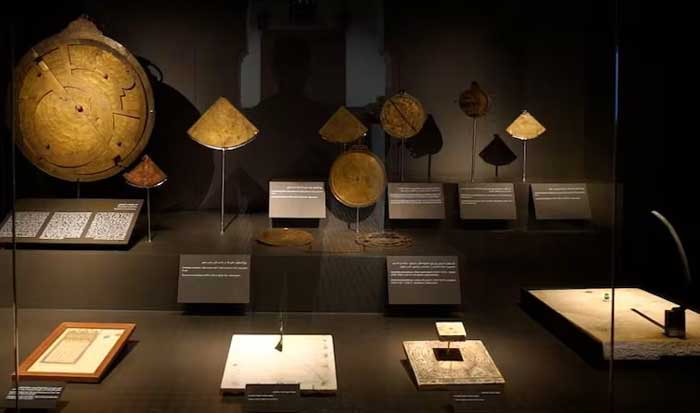
The Al Batha Museum of Islamic Arts was inaugurated on Wednesday in Fez, following the completion of restoration work launched in 2019 by HM King Mohammed VI as part of the project for the rehabilitation and enhancement of the Medina of Fez.
This museum, whose inauguration took place in the presence of the President of the National Museums Foundation, Mehdi Qotbi, the Wali of the Fez-Meknes region, Governor of the Prefecture of Fez, Mouaad Jamai, the President of the Fez-Meknes Regional Council, Abdelouahed El Ansari, the President of the Euro-Mediterranean University of Fez, Mustapha Bousmina, as well as other personalities, is one of the oldest and most prestigious museums in Morocco.
On this occasion, an exhibition was inaugurated, allowing the public to discover historical documents illustrating the various dynasties that have succeeded one another in Morocco from the 8th century to the present day, while retracing the major events and landmark moments of national history.
In a statement to MAP, Mehdi Qotbi emphasized that this "exceptional" and "fascinating" museum, opened after its restoration thanks to a Royal initiative, will contribute to strengthening the cultural and tourist offering of Morocco and Fez, a city with exceptional historical heritage.
He added that the Al Batha Museum of Islamic Arts will provide a splendid image of an Islam of tolerance and coexistence, highlighting the harmony and living-together that unite the Muslim, Jewish, and Christian communities in Morocco.
Mr. Qotbi insisted on the fact that Morocco is a model of tolerance, respect, and interreligious coexistence in a world in full mutation and crossed by numerous misunderstandings.
For his part, Abdelaziz Idrissi, Head of the Museums Department at the National Museums Foundation and in charge of the inaugural exhibition, emphasized that the museum, which covers a total area of 7,500 m², represents a major achievement of the Foundation that will contribute to highlighting Moroccan cultural richness through a structured historical and thematic journey.
Mr. Idrissi specified that the museum offers visitors a museum collection of great value, exhibited for the first time, which can rival the most prestigious collections dedicated to the history of Islamic civilization in the Mediterranean.
Among the pieces exhibited are documents retracing the history of writing in Morocco and the evolution of Arabic calligraphy, as well as iconic objects such as the "Adouate Al Andalous" minbar, one of the few in the Islamic world, he continued, specifying that the exhibition also highlights the role of Morocco in the intellectual and cultural rise of the medieval world.
Mr. Idrissi noted that the museum's collection covers the various periods of Moroccan history, from the pre-Islamic era, the foundation of the Islamic state in Fez, the successive dynasties up to the Alaouite dynasty, adding that the exhibition also addresses themes related to Moroccan lifestyles and cultural specificities.
A special space is dedicated to the city of Fez, highlighting its historical role and its contribution to the dissemination of knowledge and Moroccan culture through the centuries, he affirmed.
For his part, the museum curator, Alaa Fechtali, noted that the restoration of the Al Batha Museum was carried out under the supervision of the National Museums Foundation and the Agency for the Development and Rehabilitation of Fez, in respect of the architectural and historical authenticity of the site.
He also emphasized the history of the museum, which was initially a palace built during the reign of Sultan Moulay Hassan I between 1873 and 1894, as a summer residence and a place for receiving dignitaries. Its completion and embellishment were carried out by Sultan Moulay Abdelaziz in 1897.
The inauguration of the museum was marked by the presence of several renowned cultural figures, including physicists Alain Aspect and Serge Haroche, both Nobel Prize winners in Physics.
In this context, Serge Haroche, born in Morocco, expressed his deep joy at visiting this museum, highlighting the importance of its exhibition on the history of Morocco and its relations with Spain and Portugal.
He added that the museum offers an exceptional opportunity to explore cultural exchanges between pre-Islamic and Islamic civilizations, noting that Morocco constitutes a unique and exceptional model of interreligious coexistence and tolerance.
For his part, Alain Aspect expressed his pride in visiting the Al Batha Museum of Islamic Arts, praising the quality of the explanations provided by the experts on the cultural treasures contained in this exceptional place. He also expressed his admiration for the Kingdom's cultural vision.