

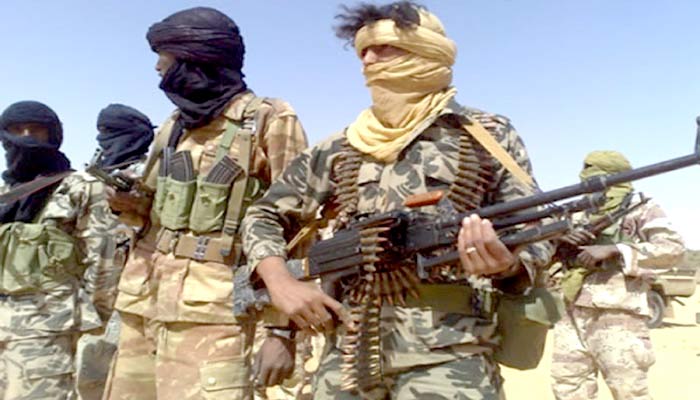
The signals were there, visible to anyone who wanted to read them. But the latest report from the Spanish National Intelligence Centre breaks the silence that has surrounded the drift of the Tindouf camps for years.
These Algerian enclaves, erected by the puppets of the Polisario as bastions of a worn-out separatist struggle, are revealing themselves today for what they have become: incubators of radicalism, breeding grounds for the most dangerous jihadist organizations operating in the Sahel-Saharan strip. This dramatic turn, long feared by analysts, confirms the resounding failure of the international community to prevent an explosive convergence between armed separatism and religious extremism.
The Spanish alert cannot be minimized. These are no longer just isolated individuals leaving the camps to join the ranks of Al-Qaeda in the Islamic Maghreb or the Islamic State in West Africa. They are now operational cadres from the Polisario who are accessing command positions within these terrorist nebulas, at the heart of what European services now qualify as a “planetary red zone”. The transformation is all the more worrying as these profiles, often young, speak Spanish, know European social codes, and master the geopolitical dynamics of the region.
What is at stake here goes far beyond the framework of an artificial regional conflict. The Sahelian front is no longer a distant fault line. It has turned into a global battlefield, where armed groups operate with complete freedom, test their capabilities, and project their ambitions beyond porous borders. The arc of destabilization now runs from the Chadian basin to the shores of the Atlantic, passing through Mauritania, Mali, Niger, and southern Algeria. And in this fractured landscape, the former children of the Tindouf camps appear as the new faces of a regionalized jihadism with transcontinental ambitions.
What this Spanish report also reveals is the depth of the failure of the Algerian model of camp management. For five decades, these zones have escaped all international control. Algeria categorically refuses any census of the populations, prevents access to independent observers, and lets the Polisario manage the places with an iron fist and absolute opacity. This administrative, institutional, and humanitarian vacuum has generated fertile ground for all kinds of drifts. The lack of hope, marginalization, and ideological indoctrination have paved the way for systemic, methodical radicalization, irrigated by increasingly structured jihadist networks.
The analysis of the current Sahelian situation cannot avoid a lucid observation: the Tindouf camps are no longer just humanitarian or political issues. They have become constituent elements of regional instability. They generate ideological labor at the service of violent and transnational agendas. The shift from separatism to jihadism is no longer an exception, but a trend, encouraged by the porosity of borders, the weakness of states in the Sahelian strip, and the cynicism of a regional sponsor who washes its hands of the consequences.
Spain, now on the front line, can no longer afford the strategic myopia it has long shown. Madrid is brutally realizing that the ramifications of the Sahelian chaos can strike at the very heart of Europe. The two individuals recently arrested in the Basque Country, with family ties to Polisario figures and suspected of terrorist propaganda, are only the tip of the iceberg. Behind these facts looms a much more worrying reality: the possibility of a slow but effective infiltration of extremist ideologies into the European social fabric, via cultural, linguistic, or community channels.
This shift imposes a radical overhaul of European security paradigms. It is no longer just a matter of containing the threat, but of neutralizing it at its source. And this source, increasingly, is located south of the Maghreb. Faced with this, Morocco appears as an essential partner. Not only because of its geographical proximity, but above all thanks to the proven effectiveness of its security apparatus, the density of its human network in the region, and its ability to infiltrate terrorist networks using proven methods. Cooperation with Rabat is no longer a variable-geometry diplomatic choice. It is a strategic imperative for Europe.
Because what is at stake is not just the stability of the Sahel or the fight against a few stray groups. It is the very architecture of Mediterranean security that is wavering. The collapse of Sahelian states, the emergence of new forms of hybrid alliances between traffickers, insurgents, and jihadists, the growing militarization of the Sahelian strip, and the domino effect on migration and illegal flows represent a systemic threat. And this threat today takes on a Spanish-speaking hue, with direct ramifications towards Western Europe.
Far from being a simple warning, the report from the Spanish intelligence services sounds like a declaration of emergency. Europe is now within breathing distance of Sahelian jihadism. And at the origin of this new reality, there is an actor that has been treated for too long as a legitimate interlocutor.
It is time to demand accountability from Algeria, whose policy of blind hosting of the Polisario has allowed these drifts to proliferate. The international community, and first and foremost Europe, must impose transparency in the Tindouf camps, demand an immediate census of the populations, put an end to the state of exception that prevails there, and sanction any support – even tacit – for extremist networks.
Mehdi Ouassat